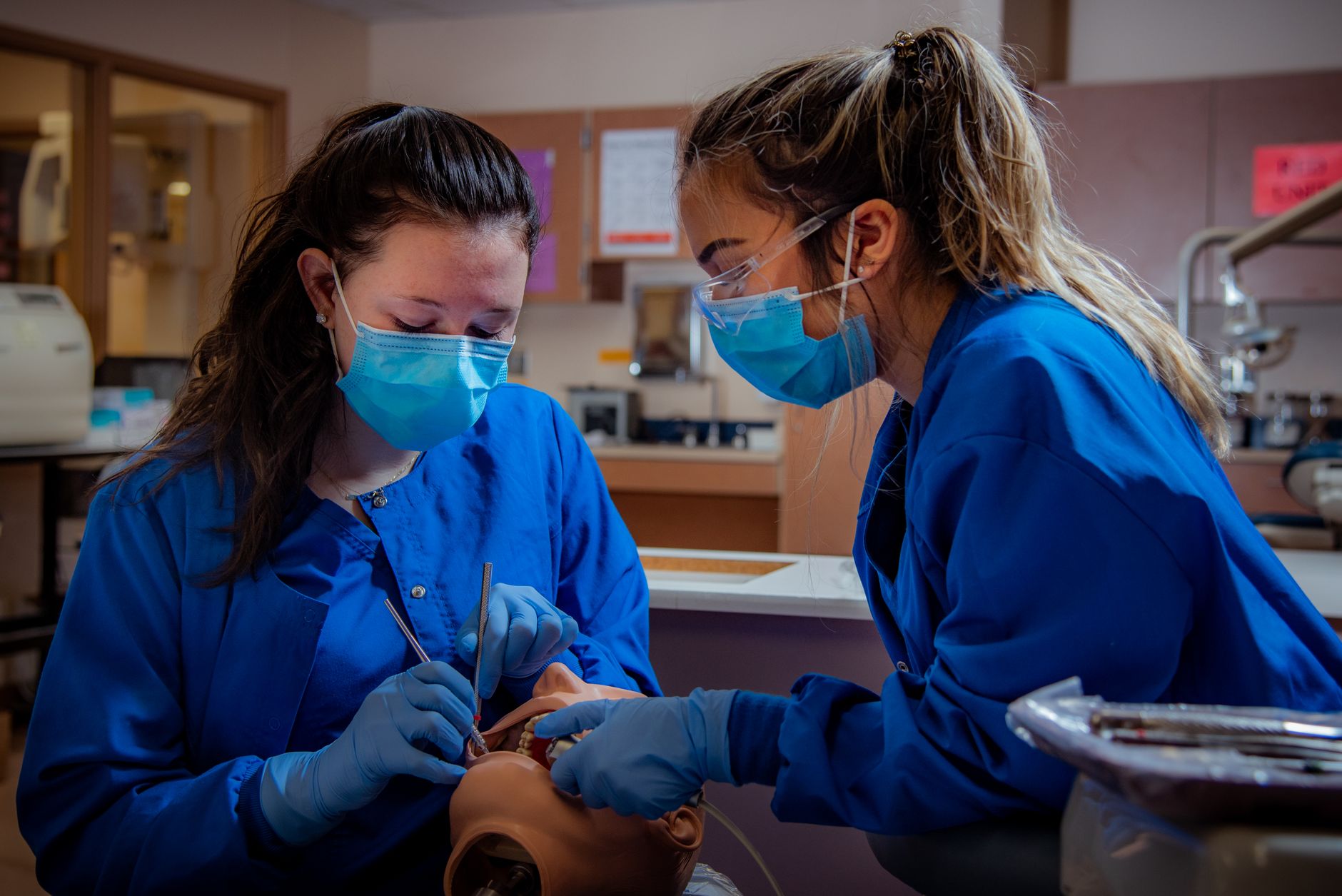
What a Dental Assisting Associate Degree Adds
A certificate or diploma teaches you to be a dental assistant. A dental assisting associate degree teaches you the same chairside skills, then adds general education courses such as English, math and the sciences. The dental part is often identical: at Kirkwood Community College, the AAS is three semesters of dental coursework plus additional courses, the same dental core as its diploma.
So the degree costs you more time and money for the same entry-level job. It pays off in a few specific situations:
- You plan to keep studying. General education credits can count toward another degree at a college that accepts them.
- You want a degree on your résumé for supervisory, office manager or teaching roles later.
If none of those apply, a certificate or diploma from a CODA-accredited program gets you to the same exams sooner. The certificate vs diploma vs degree guide compares all three.
How the 66 Associate Degree Programs Compare
| Measure |
Associate degrees |
All 430 programs |
| Programs |
66 |
430 |
| States |
24 |
47 |
| CODA-accredited |
33 |
143 |
| At public colleges |
58 |
299 |
| Name a DANB exam |
24 |
174 |
| Hybrid or online |
13 |
78 |
| Median stated length |
78 weeks |
40 weeks |
| Median credits |
61 |
45 |
33 of the 66 associate degree programs state CODA accreditation. California and Minnesota have the most, with 12 each, then Texas with 6 and Alabama and Washington with 5.
The Top Associate Degree Programs
The ranking scores each degree on published outcomes, CODA status, published cost, federal awards and schedule. All ten leaders are CODA-accredited public colleges:
- Kirkwood Community College, Cedar Rapids, Iowa (score 97): a 63.5-credit AAS at $229 per credit in-state, with a 2026-27 page estimate of about $17,542.50 for the degree.
- John C Calhoun State Community College, Tanner, Alabama (95): 46 federal dental assisting awards.
- Minneapolis Community and Technical College (94): a 60-credit AAS.
- Ozarks Technical Community College, Springfield, Missouri (94): two years over four semesters, with a program cost range of $14,458 to $18,328 on its page.
- Cerritos College, Norwalk, California (93): an A.A. alongside a 10-month certificate, leading to DANB exams and the California RDA.
- Grayson College, Denison, Texas (93).
- Lake Area Technical College, Watertown, South Dakota (92): a 20-month AAS with an estimated second-year cost of $7,946 in 2026, on top of year one, and a hybrid option.
- Central Lakes College-Brainerd in Minnesota (91), Del Mar College in Corpus Christi (90) and Flint Hills Technical College in Emporia, Kansas (90), a two-year AAS that names DANB and starts in fall.
What Associate Degrees Cost
Only five associate degree programs publish a full total:
College of the Redwoods’ $4,000 covers the program; registration and exam fees are separate. Minnesota North lists $12,033 tuition plus $1,296.60 in student fees, for $13,329.60, with books and class materials extra. Amerion’s $16,750 is a full-time maximum with textbooks included, plus online fees of $125 per class.
Other colleges post rates or their own estimates: Kirkwood about $17,542.50, Dakota County Technical College about $18,515.05 for 2026-2027 at $234.03 per credit plus fees, Southeast Community College an estimated $7,620 in tuition plus $400 in supplies and fees and $1,000 for books, and Chaffey College about $800 per semester. The school cost comparer helps you compare them.
Same Training, Two Timelines
Many schools offer the degree and a shorter credential side by side, and the dental courses come first. That gives you a choice partway through:
- University of Southern Indiana in Evansville builds its 60-credit Associate of Science from a certificate year plus a second academic year.
- Sacramento City College finishes the dental major in one year, but the degree needs 60+ units with general education. Its graduates passed the California RDA exam at 90% (18 of 20) in 2024-2025.
- Cerritos College, Chaffey College and Allan Hancock College in California pair a certificate with an A.A. or A.S.
- Minnesota West Community and Technical College runs its AAS over four full-time semesters with ten weeks of extramural clinical experience, and also offers a diploma.
If a school offers both, you can often start in the degree and decide later, or finish the certificate, start work and come back for the general education.
Associate Degrees That Fit Around Work
Flexible associate degrees are rare. Only 3 list evening, weekend or part-time options:
- Herzing University-Minneapolis runs a 68-credit hybrid AAS over 20 months, with lab and clinical work one or two weekends a month. It’s CODA-accredited and leads to Minnesota’s licensure and jurisprudence exams and the DANB CDA. The rate is $530 per credit, and base tuition is $36,040 plus per-semester fees, through Summer 2027.
- Dakota County Technical College in Rosemount, Minnesota, offers day and evening study for its 60-credit AAS.
- Southeast Community College in Lincoln, Nebraska, lists full-time and part-time study, on campus or hybrid, over 4 terms.
Hybrid options also include Clover Park Technical College in Lakewood, Washington, an Associate of Applied Technology over about five quarters, and Houston Community College, a 60-credit AAS over two years full time. The online and hybrid ranking lists the rest.
Where the Associate Degrees Are
Associate degrees cluster in a handful of states, and each state’s programs have their own shape.
California (12 programs). Most California colleges pair a one-year dental core with an A.S. or A.A. and point you to the California RDA. Reedley College runs classes from mid-August to mid-May with 170 hours of work experience in a dental office, and includes radiology, pit and fissure sealants and coronal polishing. San Jose City College prepares you for the California RDA and a DANB exam. Allan Hancock College in Santa Maria adds certificates in radiography, coronal polishing, sealants, and law and ethics with infection control.
Minnesota (12 programs). Minnesota’s leading degrees, at Minneapolis Community and Technical College, St Cloud Technical and Community College, Century College and Central Lakes College-Brainerd, are CODA-accredited, and St Cloud and Century name the state board exams. Minnesota North College in Hibbing publishes the clearest price of the group. Read the Minnesota requirements for the licensure route.
Texas (6 programs). Grayson College, Del Mar College, Tyler Junior College, Houston Community College and San Antonio College all offer a CODA-accredited AAS. San Antonio College’s runs three semesters of dental courses with fall entry only.
Alabama and Washington (5 each). In Alabama, H Councill Trenholm State Community College admits one class each August, and George C Wallace State Community College-Hanceville takes applications from March 1 to June 1. In Washington, Bates Technical College in Tacoma lists a 90-credit AAS over four to five quarters.
One private option stands out for speed: ECPI University in Virginia Beach runs a 63-credit AAS in 15 months on a year-round accelerated schedule, with a 10-week externship built in and DANB named on its page.
Pass Rates and Outcomes
Only two associate degree programs publish an exam pass rate. Sacramento City College reports a 90% California RDA pass rate for 2024-2025, with 78% completion (28 of 36). Coastal Alabama Community College reports DANB certification pass rates of 70% (2022-23), 60% (2023-24) and 73% (2024-25) for its five-semester AAS, which costs $12,648 in-state for 62 credits at $204 per credit, plus a supply kit, uniforms and books.
That’s a thin record, so lean on CODA status and the clinical details instead. Pikes Peak State College in Colorado Springs requires at least 300 clinical hours in its 65-credit AAS. Salina Area Technical College requires DANB testing to complete its degree and lists more than 300 clinical hours. The pass rate ranking covers every program that publishes one.
Who Should Choose the Degree
- Choose the associate degree if you want credits that count toward further study, if a degree matters for the roles you’re aiming at, or if your state’s best program near you happens to be a degree.
- Choose a certificate or diploma if you want to start working as soon as possible, or if you’d rather earn while you decide about more school. Many colleges let you finish the dental core first and come back for the general education courses later, so the certificate doesn’t close the door on the degree. The accelerated programs ranking lists the shortest options.
Either way, check your state’s rules first. Credentials differ across the 17 states published so far, including Texas, California and Washington. The requirements checker shows yours, and the school finder shows degree programs near you.